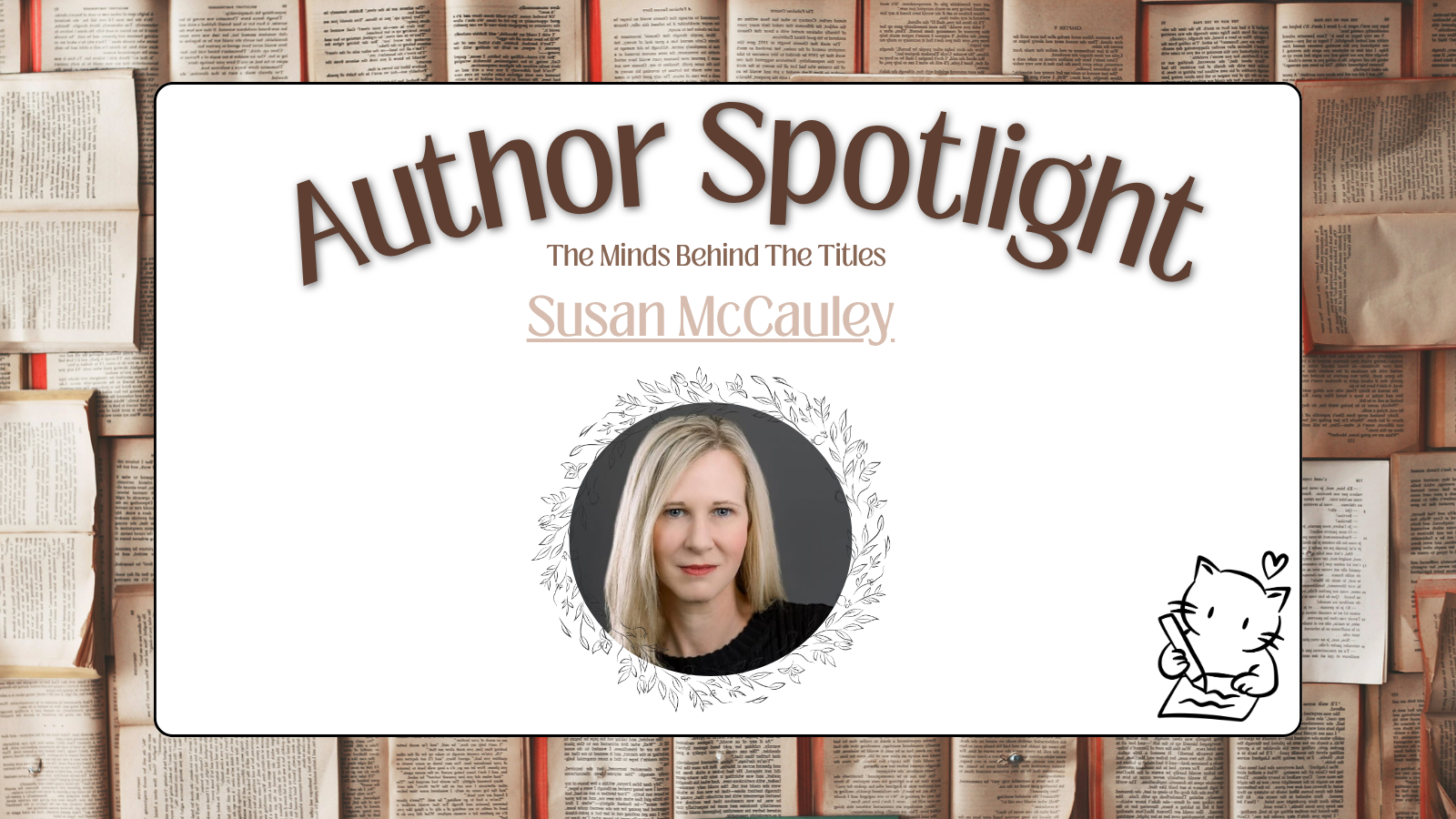
Sometimes, you come across authors who capture your entire heart and mind with a single title, and you instantly realize that you will be a lifelong fan of them and will read every single book they write. That is how I became a forever fan of Susan McCauley! Join me in this interview to take a look at her creative process and her amazing works!
About the author

Susan (Basso) McCauley is an award-winning author and screenwriter whose work spans children’s, young adult, and adult fiction. A lifelong lover of writing, theater, and film, she holds degrees from the University of Houston, USC, and RADA/King’s College London. Her work includes nine novels, a novella, and a picture book, with several titles featured on the Horror Writers Association’s Recommended Reading List.
Susan is the author of the acclaimed Ghost Hunters series, which has won numerous awards and is currently in development for television. Her upcoming gothic horror novel, The Raven, is scheduled for September 2026 and is also being developed for film. Beyond writing, Susan enjoys travel, photography, and diving, and is a second-degree black belt in taekwondo.
Looking at the breadth of her work, achievements, and seemingly endless creativity, it’s easy to imagine how excited, honored, and grateful I feel to have the opportunity to do this spotlight interview with her, especially ahead of the release of her highly anticipated upcoming novel, The Raven.
How it all started
- Your love of writing began when you were just eight years old. Do you remember the moment you first realized that storytelling was something you wanted to pursue? Or what made you sure that this would be your career path?
My love of storytelling coalesced when I was eight. That was the age when I started writing a lot, and it was also at that time I started doing visual storytelling. My father was a huge photography buff. So, I’ve always had cameras around: video cameras, film cameras, then digital cameras.
So, when I was eight years old, my dad let me use his cameras for both photography and videography. (Yep, I’m old enough (scarily) to remember using non-digital video cameras. LOL.) Anyway, I wrote short scripts, cast my cousins in parts, and shot short films using my dad’s video camera in the summer. I remember the content of the films was serious, but the results of my efforts were hysterically funny. Even as kids, we would laugh until we cried watching what I’d shot.
I think it was after that summer, when I returned to school, that my writing really took off. In fifth grade, I sat in during recess to finish an English essay, and I would write copious amounts of poetry for extra credit. Storytelling has always been part of my life; however, I didn’t really make the conscious decision to pursue it until I was sixteen and a freshman in college. (I started university pretty young, but that’s a different story…)
When I first started at the University of Houston, my mom had me register as a business major—even though I was less than thrilled with the idea. Then, during the first day of my accounting class, I realized (in full-on tears) that this was 100% the WRONG thing for me. So, I left class and went to a pay phone. (Yep, we’re in pre-cell phone era here!) I called my mom and told her, “I can’t be a business major. I’m going to double major in film and theatre.” She asked if I was sure. I said, “Yes.” She wanted to know how I was going to make a living, and I remember telling her I would just have to figure it out.
- You went on to study radio-television, theater, professional writing, and text and performance. Looking back, how did those different areas of study shape the writer you eventually became?
As you can tell, I went to school a lot. More than I needed to, most likely. But I love learning. And I think the structured learning environment that university provides is why I kept going back. Writing, as a career, is quite nebulous. There is no step-by-step formula to achieve your goals… In university, there was. I knew the work I had to do to get an A, and I’d do it. Achievement unlocked. So, in hindsight, I think that’s what kept taking me back to college.
All that said, all of the schooling I’ve had certainly hasn’t hurt me as a writer. Every experience, every piece of text I’ve read or performed, has helped me learn more about the human condition. More about craft. My study and experience with acting directly feed into how I write characters and dialogue. My study of martial arts links in well when I’m writing fight scenes or action sequences. Everything is related, sometimes tangentially and sometimes directly. My studies and related experiences have helped build my craft, my resilience, and my appreciation for story. But it’s life that has given me most of the fuel for what I write.
- You’ve also worked as an actor and studied with Robert Carnegie and Jeff Goldblum. How has your experience with acting influenced the way you develop characters and hear their voices?
I first started studying professional acting with Chris Wilson and her son, Brandon Smith, both of whom have passed now, in Houston when I was 15. At Chris Wilson’s Studio for Actors, we learned Stanislavski. Then I moved to Los Angeles and studied with Bob (Robert Carnegie) and Jeff (Goldblum), where we strictly focused on the Meisner Technique. Meisner is great, but I always felt certain limitations with it. It wasn’t until I went to the Royal Academy of Dramatic Art (RADA) and was exposed to multiple different acting teachers and techniques that I came to better understand various ways of approaching a character (emotionally, physically, and mentally). There is a lot to be said for physical action (at least for me)!
As for your question, I approach writing characters much the same way I did as an actor. However, as a writer, I’ve got a lot more characters to deal with! I don’t go into as much backstory and internal development for minor characters as I do for main characters, but I definitely have overviews of everyone. I get a feel for their personalities, their traits, their lifestyles. Then, as I write, I sink into the psychology and physicality (as much as possible) of each character. This helps me, I hope, give each character an authentic voice (even if it sometimes makes me feel like I’m going a bit crazy. LOL).
Ivy’s note:
***“At this point, my admiration—and unabashed fangirling—is officially off the charts!***
- You’ve written across several genres and age categories, from children’s and middle-grade fiction to adult fiction and screenwriting. What has kept you interested in exploring such different forms of storytelling?
I think this all goes back to my childhood. I started with short scripts and films and poetry. My fiction came later. But I think I’m a fairly visual writer—be it screenwriting or fiction. (I can write song lyrics, but I do NOT fancy myself a poet!) My favorite forms are the feature-length screenplay and the novel. I like having the structure that each provides while also having the room to explore story and character (and, in fiction, it’s especially fun to play with language and create atmosphere). Other than this, I’m not sure. I honestly think I was born to be a writer. I just feel compelled to write; I think it’s how I process and explore life. It’s certainly how I prefer to express myself.
The journey into gothic horror
- Your Ghost Hunters series already explores supernatural themes. Did that experience make the transition into adult gothic horror easier, or did The Raven require you to approach the supernatural in a completely different way?
That’s an interesting question, but I’m not sure I have a clear answer. I actually started writing the play, The Lost Children of York, which eventually became The Raven, years before I even conceived of my Ghost Hunters novels. I think the key element for me is my interest in ghost stories and the supernatural. My parents took me to Disney World when I was three years old. I still remember going on the Haunted Mansion ride. I was terrified, and when I saw there was a ghost in the seat with us at the end of the ride, I ended up on the floor crying and holding on to my parents’ legs. But I was also intrigued and mystified. And as soon as we got off the ride, I begged my parents to take me again. (My mother tells me we went three or four times in a row.) To my knowledge, that was my first experience with “ghosts.” Despite the fear, something about that world drew me in. Part of it, I think, is the curiosity of not being entirely sure what’s beyond when we die. That tie to various myths, cultures, and religions is fascinating to me on so many levels.
- What drew you toward gothic horror at this stage of your writing career?
I’ve always been a fan of gothic and psychological horror. I love the works of Edgar Allen Poe, Shirley Jackson, and Susan Hill. (I’m also a fan of Richard Matheson and Stephen King.) The first time I read Shirley Jackson’s The Haunting of Hill House, I was twenty or twenty-one years old, living alone in Los Angeles. It scared me so much I slept with the lights on for nearly a week! There’s just something about getting inside the mind of humans that fascinates me. I like exploring the darker side of human nature and discovering ways the light can shine through. I also find it fascinating trying to understand how and why some people can do the awful things they do. Personally, I can’t understand a lot of it on a surface level: rape, murder, abuse. So, by writing, I dig deep and try to figure out what could make someone do those types of things… and were they good or bad to begin with? If they were good, what on earth drove them to take such dark measures?
- What was the biggest difference between writing supernatural elements for younger readers and writing gothic horror for an adult audience?
R.L. Stine rarely lets main characters die in his Goosebumps books and relies heavily on jump scares. I like that style of book for kids, but I also enjoy slightly darker works like Jonathan Stroud’s Lockwood & Co. I read several books from each of these authors (along with many others) before and during my time writing the Ghost Hunters series. I think ensuring there is an element of fun in the supernatural books for young readers is super important. I like to think of my Ghost Hunters series as “spooky fun,” so kids can get scared, face real-life problems and consequences, and giggle all in the same book. For adult gothic horror, at least in my first one, there isn’t much fun to be had! LOL. It’s a full-on examination of life and a man’s descent into being haunted or driven mad (or both). So, I can take the metaphorical gloves off when writing adult fiction. Of course, adults still want to get some enjoyment from what they’re reading, but it doesn’t require the same element of fun that I like to infuse in kids’ books.

- Now that you’ve entered the gothic horror space, is this a direction you’d like to continue exploring in future books?
I would definitely like to write more gothic horror; however, my reps are encouraging me to write modern (not historic) works. So, I will likely explore gothic elements in future works whenever I have the opportunity. The novel I’m currently working on is a modern adult horror. There are no vampires in it, but I’m hoping to capture a similar vibe to Salem’s Lot in this one. We’ll see. I’m still not finished with the first draft and have had to take a break from it to work on a screenplay revision.
the raven

- Were there particular Gothic authors, books, films, or other works that influenced you while writing The Raven?
The initial works I looked at while writing The Lost Children of York (later to become The Raven) were Hamlet (1603) by William Shakespeare, The Woman in Black (1983) by Susan Hill, and A Journal of the Plague Year (1722) by Daniel Defoe. There was also an obscure play about murdered orphans that my tutor at RADA had me read, but I cannot recall the title. I also spent time in York, England, visiting museums, looking through documents at the York Minster Library, and chatting with one of the librarians at the York Minster Library who had also heard the same ghost story as I had, which was the seed from which The Raven was born.
- Gothic horror often relies on atmosphere and psychological tension as much as outright scares. How did you approach creating that sense of unease in The Raven?
I immerse myself in the sense of place and people I’m trying to create. For me, this started a long time ago by spending time in York during January. I allowed myself to get chilled to the bone so I could really feel what it must have been like for all the people in times before proper insulation, good clothing, and central heating. (Although I’m sure there are still people who live there today who struggle during the winters.) I’ve never felt colder in my life than when living in England. I’ve been to colder places and experienced colder temperatures, but there’s nothing like waiting on a train platform in subfreezing temperatures with the mist in the air, needling its way through your clothes and into your bones. It’s hard to get warm from that.
So, I suppose, the answer is that I begin with research. From the research, I use my imagination and what I’ve learned over the years in terms of craft (from both acting and writing) to immerse myself in the world. I visualize what I want to create and then begin writing it. First drafts are beastly. I’ve learned to just get the guts of the story and characters down on the page, and not to expect it to be good. While there may be some things I will keep and use, the writing doesn’t even begin to get good until the revisions start.

- Was there a particular image, scene, character, or idea that sparked The Raven in the first place?
The Raven was first started when I heard a ghost story on a York City tour back in 1999. Over the years, there have been reports of the ghostly voices of children wailing from an open field. Rumors say that a man who had cared for the children went insane and killed them all. That story stuck with me. And from that story, I set out to do research. Yet no records or librarians could provide me with historical answers. So, I decided to build a world around that story and create what might have happened there. I began asking myself: what could drive someone so insane that he would murder all of the children in his care? And why would they still be trapped there?
- Did writing The Raven change the way you think about fear as a storytelling tool?
As a reader and a writer, I generally prefer psychological horror to jump-scares and gore. (I’m not really a fan of gore at all. Now, if you’ve read my novella, The Demon Tailor, you may question me on that. BUT, the gore in that book came authentically from the story… and it was VERY emotionally difficult for me to write).
The Raven itself hasn’t changed the way I think about fear as a storytelling tool, but the more horror I write, the deeper I continue to dig and ask questions: why do people like reading horror? Why do they like seeing horror? Why do they purposefully choose to be scared? I’ve read some very interesting non-fiction on the subject of fear. A lot of it comes down to personal experience and brain chemistry— much of that determines what type of fear people embrace (or not). It’s a fascinating area of research.
- Do you feel that The Raven brought together some of your different creative passions—writing, theater, film, and the supernatural—in a way your previous work hadn’t?
The unique thing for me about The Raven is that I originally wrote it as a play. I kept getting rejections from theatres that it was too visual. So, I later adapted it into a screenplay. The screenplay is in development and is slowly gaining momentum; I’m hopeful we will actually go into pre-production sooner rather than later. It was actually one of the producers on The Raven film who encouraged me to adapt the screenplay into a novel. (And The Raven IS a novel. Some readers seem to think it’s a novella, but at over 50,000 words, it sits squarely in the novel category—even if it’s a short one.)
- Without giving away any spoilers, what can you tell readers about The Raven and the kind of experience you hope they’ll have while reading it?
Here’s an overview of the book:
As illness tightens its grip, something darker begins to stir.
England, 1665. As plague ravages London and fear spreads north to York, Martin Blake, a humble cobbler, struggles to protect his family through a bitter, death-shadowed winter. When the parish rector, his wife’s domineering uncle, forces orphaned children from London into their already meager home, Martin’s fragile world begins to unravel.
Grief, illness, and the weight of buried sins close in. Ravens gather. Martin’s reason begins to slip. Whispers spread—of misused alms, of spirits that roam at night, of faith twisted into something monstrous. As snow blankets the land and the dead lie unburied, Martin must confront a chilling truth: is he haunted by guilt, or by something far more sinister?
A gothic tale of illness, obsession, and the perilous border between loyalty and madness.
The Raven is really meant for readers who enjoy slow-burn, psychological horror and historical fiction that immerses them in the period and makes them think. If they enjoy that type of book, they will, hopefully, enjoy The Raven.

- What do you hope readers will still be thinking about the morning after they finish The Raven?
I hope they will question if men (or women) who commit horrific acts are always truly evil—or if life events caused them to do evil things. I hope they will question if Martin was mad or truly haunted. Finally, I hope it will make readers consider the fragile and complex psychology that makes us human.
the future
- Your Ghost Hunters series is also in development for television. What is it like watching stories that began in your imagination potentially leap to the screen?
I would LOVE to see my Ghost Hunters adapted for TV. The process is long and hard. We’ve got a fantastic, experienced showrunner for the show, but Hollywood is a bit of a mess right now, and getting shows greenlit (that aren’t already major, established IP is HARD). But I’m tenacious, and I’ll keep on working at it.
- After publishing nine novels, a novella, and a picture book, what do you know about yourself as a writer now that you wish you had known when you were writing your first book?
I wish I already had the patience and discipline that I have now in place when I wrote my first book—which has never been published (along with a few others). But that’s the conundrum. It took writing all those books (and short stories) to gain the patience and discipline needed to write, revise, and have the stamina to handle the writing process, along with the constant critiques and rejection.

Your ultimate comfort read?
I honestly don’t know the answer to this. I guess it depends on why I’m seeking comfort. If I’m hurting because of loss, maybe one of the Psalms from the Bible. If I’m just tired and done with the world, I’m probably happy escaping into a fantasy or horror novel.
A fictional world you’d love to spend a week in?
I’d love to spend a week at Hogsmeade and Hogwarts. Yes, I’m somewhat of a Potterhead. LOL!
Haunted house, vampire, or ghost—which would you rather face?
Haunted house.
Describe The Raven in three words.
Haunting. Gothic. Human.
A huge thank you to Susan McCauley for agreeing to do this interview with me, sparing her valuable time in her extremely busy schedule, inspiring me (and hopefully all you readers who read this interview), and sharing her real-life inspirations along with an invaluable look behind the scenes.
If you are a gothic, psychological horror fan who appreciates emotional depth, historical fiction, and slow-burn tension, make sure you mark your calendars for September 8 and make space on your bookshelves for The Raven!

Leave a Reply